
The wood makes the fire
August 20265 min read
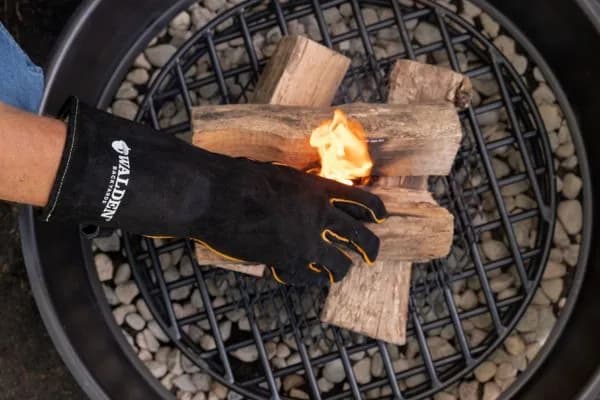
You can build the perfect structure (see 'A Better Fire Starts Under the Wood'), light it from below, and still spend the night in smoke, because the wood was cut in spring and stacked last month. Fresh-cut wood is heavy with water, and a fire has to boil that water off before it can burn a single fiber. That is what green-wood smoke is: steam and unburned fuel, hissing its way out of your evening while the fire runs cold and everyone quietly moves their chairs back from the smoke instead of toward the warmth.
Wood is the one ingredient in a fire you cannot fix at the pit. Technique can rescue a badly built fire in minutes; nothing rescues wet wood except months on a stack. Which is why the fire person in every family is, quietly, a wood person first. This is the foundation that makes every other article in the almanac work.
Reading a seasoned log
Seasoned wood announces itself to every sense you point at it. Pick up a log and run the checklist:
- The end grain is cracked and grey. Checks radiating from the center mean the water has left and the wood shrank behind it.
- Two logs knocked together ring hollow, like a bat off a ball. Green wood answers with a dull, wet thud.
- The bark is loose or falling off. On green wood it grips like it grew there, because it did, recently.
- It feels light for its size. Water is heavy; its absence is obvious in the hand.
Water is heavy. Its absence is obvious in the hand. A seasoned log practically volunteers.
No single check is proof, but wood that passes all four is ready, and wood that fails two of them is going to hiss at you. Run the checklist on delivery day, not fire night, and there are no surprises.
Hardwood is the evening, softwood is the match
Dense hardwoods, oak, maple, hickory, ash, burn slow and settle into the thick coal beds that cooking and long conversations are made of. Softwoods like pine catch fast and burn out fast, which makes them superb kindling and a frustrating main event: a pine-fed fire needs feeding all night and leaves thin coals behind. The ideal wood pile holds both, doing different jobs, soft to start, hard to stay.
If you cook over your fire, the species choice earns one more thought. The classic cooking woods, oak, hickory, maple, and the fruit woods like apple and cherry, burn to clean coals and lend the smoke that barbecue is named after. Resinous softwoods are the wrong tree for dinner: pine coals carry a sooty, turpentine edge you can taste. Save the pine for lighting the fire; let the hardwood cook the meal.
A year in the stack
Seasoning is not a process you run; it is a wait you schedule. Split wood dries from the exposed faces inward, which is why splitting matters as much as time. A round left whole keeps its water behind bark for years, while the same wood split open gives it up over a stretch of seasons. As a working rule, most hardwoods want about a year in a good stack; dense oak appreciates longer, and softwoods come ready sooner. The practical upshot: this year’s wood order is next year’s fires, and the household that stays a year ahead never burns a green log again.
Store it like you mean it
Seasoning is just storage done right, and good storage is three rules. Off the ground: a stack on pallets, rails, or a rack lets air walk under the pile and keeps the bottom row from wicking soil moisture and rotting where it sits. Top covered: rain runs off a roof, a strip of metal, a board, the top of a rack cover. Sides open: wind is doing the actual drying, and it needs a way through.
The tarp mistake deserves its own sentence: a tarp wrapped down over the whole stack feels diligent and does the opposite. It holds every exit shut and steams the wood in its own moisture. Cover the roof, never the walls. Site the stack where sun and prevailing wind can reach it, a hand’s width out from any fence or wall so air moves behind it, and stack a single row deep if you have the room, every log gets a face in the wind.
Buying wood without getting burned
Most backyards burn bought wood, and the market rewards a few pointed questions. Ask what species it is: “mixed hardwood” is fine, “mixed” alone means whatever fell. Ask when it was split, not just cut: a tree felled last year and split last week has been seasoning for a week. Ask if it is seasoned and then verify like you were taught above: knock two logs together while the truck is still in the driveway. An honest seller does not mind the test, and the other kind is exactly who the test is for. Then stack it properly the same day, because a dumped pile on wet grass starts undoing the seasoning immediately.
Make kindling when you split
The households that always have a fire going share one unglamorous habit: a kindling bin. Every splitting session, the straight-grained pieces get worked down, a few into pencil-thick, a few into thumb-thick, and dropped in a dry bin by the door with a coffee can of tinder beside it. Fire-lighting stops being a scavenger hunt and becomes a thirty-second errand. It is the difference between a household where fires happen on nice weekends and one where the fire is simply how evenings work.